
June 1, 2023 Dena Jensen
This week the Whatcom County Council put out a news flash announcement requesting that community members provide feedback to the Incarceration Prevention and Reduction Task Force about the draft version of the Justice Project Implementation Plan. I sent an email in today that will be included in this blog post.
This draft implementation plan provides many details about ways the County will take action on recommendations made by the Justice Project Stakeholder Advisory Committee, among which, besides a variety of social services, are those to build at least a couple new jails, one “for people who pose a significant threat to public safety,” and another for what is described as “alternatives for lower-risk offenders (e.g., work release).” The current Interim Work Center that is proposed to be either torn down or repurposed in the draft implementation plan is described in this way on the Whatcom County website where visiting hours are also provided for the location.
“Interim Work Center
Whatcom County Interim Work Center Services
Services at this facility include:
- Housing for minimum security and programs offenders
- Alternative Corrections Programs and administrative Staff”
One thing I discovered when I looked through the draft plan, trying to find information on funding plans for what will be the replacement for the Whatcom County Jail, was that this information was hard to find if you are just searching for where it is in the plan and haven’t read the plan sequentially.
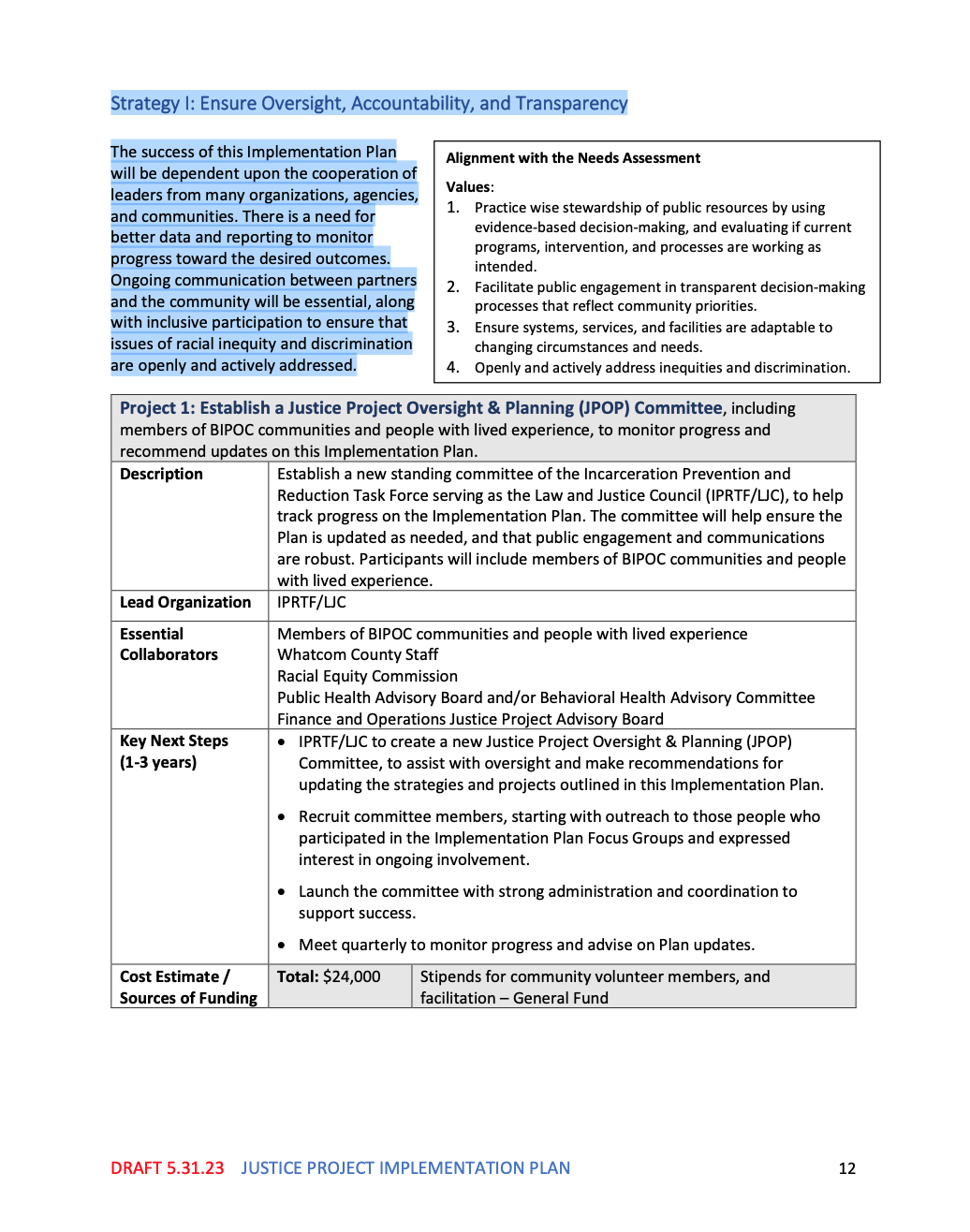
“Strategy I: Ensure Oversight, Accountability, and Transparency
__ DRAFT 5.31.23 JUSTICE PROJECT IMPLEMENTATION PLAN, Page 12
The success of this Implementation Plan will be dependent upon the cooperation of leaders from many organizations, agencies, and communities. There is a need for better data and reporting to monitor progress toward the desired outcomes. Ongoing communication between partners and the community will be essential, along with inclusive participation to ensure that issues of racial inequity and discrimination are openly and actively addressed.”
Understanding that the number one strategy outlined in the plan was for Oversight, Accountability, and Transparency, I wrote the Incarceration Prevention and Reduction Task Force about the challenges I encountered in being able to find and understand information in the plan. Below is my email.
Sent: Thursday, June 1, 2023, 09:35:53 AM PDT
Subject: Feedback on the draft version of the Justice Project Implementation Plan
Dear Incarceration Prevention and Reduction Task Force:
I received an email yesterday with the request for feedback on the draft version of the Justice Project Implementation Plan. So far, I have been able to look through the plan for specific material that I was curious about, but I haven’t gotten a chance to read the plan in its entirety yet.
One thing I did notice and wanted to write you all about is that in trying to look at budgeting specifics shown about different items in the plan, I found it challenging to gain a clear understanding of funding related to the jail as distinct from any behavioral health facilities or services.
For example, the word jail is never used in the table of contents, and there is no money-related information in chart form related to the word jail. Meanwhile, the word jail is used in the document 56 times, and in every presentation I have listened to up to this point related to the Justice Project, the word jail has been used to describe one of the facilities the Justice Project has been focusing on building. So it does not seem to be a term that the County has been viewing as obsolete.
After focusing on certain details in the draft plan and because I recognized the chart from other meetings where cost estimates on the jail have been discussed, I was able to find the first sign recognizable to me that budgeting for the jail was being covered when I found the blue chart in the Cost Estimates section on page 31.
I then went backwards from there and tried to figure out other places where financial information about the jail was available. It gradually became clear to me that the jail was being absorbed into a facility that is being called a Public Safety and Health Center. But in the description of the center in the charts, the word jail is not ever used. The word detention is used instead of jail.
I did find that in the executive summary on page 4 the proposal is mentioned of a “Public Safety and Health Center, which would replace the failing jail” but as far as I am aware this title is something that will be new to our community. While the intention of the detention facility may be clear to all of you working on the plan, I still think it will be vague and somewhat obstructive to some people who, to greater or lesser degrees review the implementation plan and seek understanding of proposed facilities, services, and funding plans.
From information in a description of Project 8 on page 20 there is material that suggests that some facility for a program like the work center will be included in this Public Safety and Health Center. And while on page 29 it is specified what vision the plan has for a location of a work center, the description of Project 8 anywhere it appears in the draft plan does not make clear that the detention facilities included will specifically be a Whatcom County Jail and a Jail Work Center and will only be these two specific detention facilities.
The other challenge with the new introduction of the Public Safety and Health Center umbrella is to an understanding of the breakdown of funding whatever detention centers you do mean to include there, as well as any diversion options, “and an integrated Behavioral Care Center (BCC) that offers inpatient mental health and substance use disorder treatment as an alternative to incarceration.” The one section of the plan on cost estimates for three location/design types of detention facilities does not include a cost to build the Behavioral Care Center, and in the section on Estimating Facility Size it is noted that Behavioral Care beds are not included in the size estimates.
The only place I can find any information on an amount of money associated with Behavioral Care is in the “Chart: Funding Available and Needed by Project Expense.”
This vagueness leads me to continue to have a lot of uneasiness about what facilities are being prioritized by Whatcom County, whether we will end up with additional detention facilities that could be harmful to our community, and whether any non-detention facilities will be amply funded to meaningfully reduce incarceration and injustice, while increasing community wellbeing.
The last issue I’ll bring up in this email is that it would be very helpful to have a list to indicate what is meant by the terms used in the “Chart: Funding Available and Needed by Project Expense” in the “Status of Funding” column and explain why some of the statuses are felt to be “Likely” or “Very Likely.” One example I can give of how the terms don’t seem to provide any sense of clear meaning is that many items are proposed to be funded by a Justice Sales Tax (JST), but have a status of “Funding Needed,” while “Estimated local share of operational costs – Crisis Relief Center,” “Transportation Services,” and “3 BH/re-entry specialists” that are being funded by a JST indicate a status of “Very Likely.”It would be valuable for there to be some way for community members to be able to measure whether more or less funds from a proposed sales tax are anticipated to be going to behavioral/mental health, substance use disorder, and housing services and facilities, than they are to detention/jail facilities.
Sincerely,
Dena Jensen
Birch Bay, WA
This email was sent to the following addresses:
To: IPRTaskForce@co.whatcom.wa.us <iprtaskforce@co.whatcom.wa.us>
Cc: council@co.whatcom.wa.us <council@co.whatcom.wa.us>; ccmail@cob.org <ccmail@cob.org>; G. CC. Immigration Board <immigrationboard@cob.org>
 noisy waters northwest
You must be logged in to post a comment.