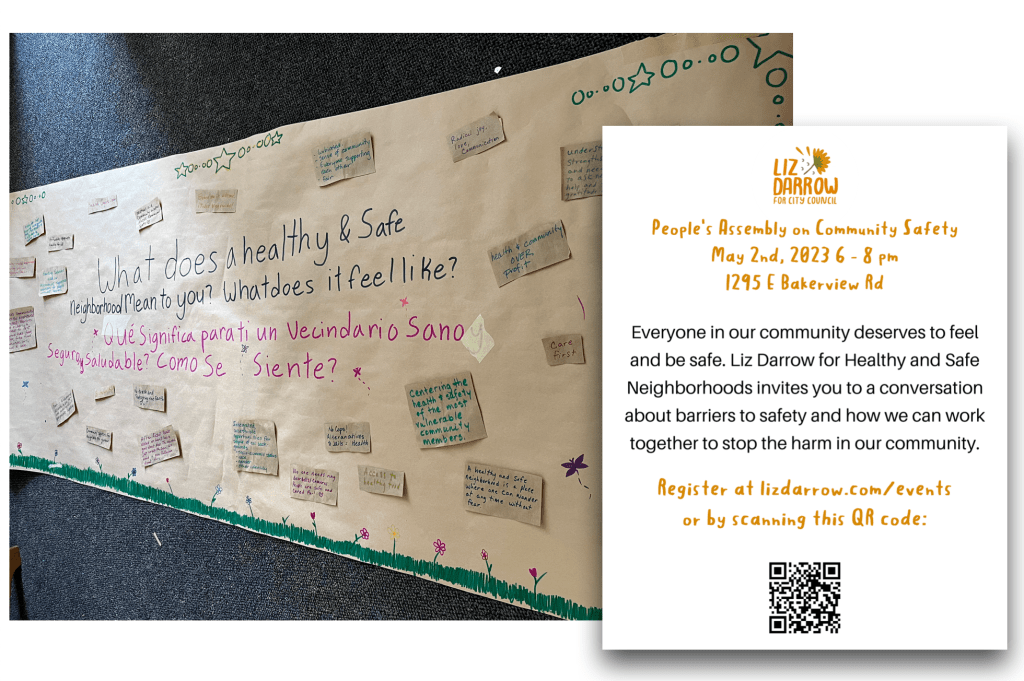
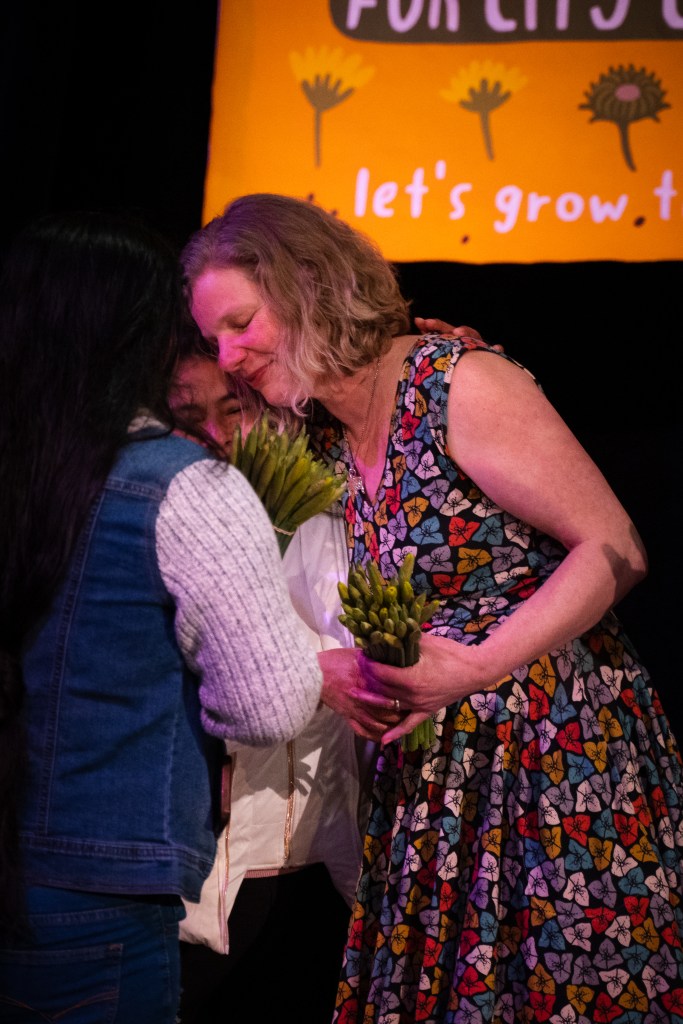
Image of community contributions made during a gathering organized by Liz Darrow for Healthy and Safe Neighborhoods. Darrow is running for Bellingham City Council Ward 3 in the November 2023 election
June 23, 2023 Dena Jensen
The 2023 election season is underway and candidates are busy making themselves known to the community. Liz Darrow is one of those candidates, and is also a person who has been making herself known to the community through her acts of showing up for many years to support and learn from those who live and grapple with challenges in Bellingham and Whatcom County. So much so, that a more home-body type like me, who lives in north Whatcom, has met her in person and is happy to keep getting to know this individual who I am lucky to be able to call a friend.
It was, therefore, my joy and honor, a little over a week ago, to sit down for my own personal ask-her-anything session with Liz as she steps up to pursue the role of a Bellingham City Council Member for Ward 3. I am especially happy about our chat, because if there are other folks who have missed the chance to get to know Liz, the transcript of the Q&A which I am providing in this post can be a start in that direction.
For those who just want to know how to interact with Liz Darrow more directly, you can scroll down toward the bottom of this post where there are plenty of links and addresses that will allow you to do that.
Without further ado:
Dena:
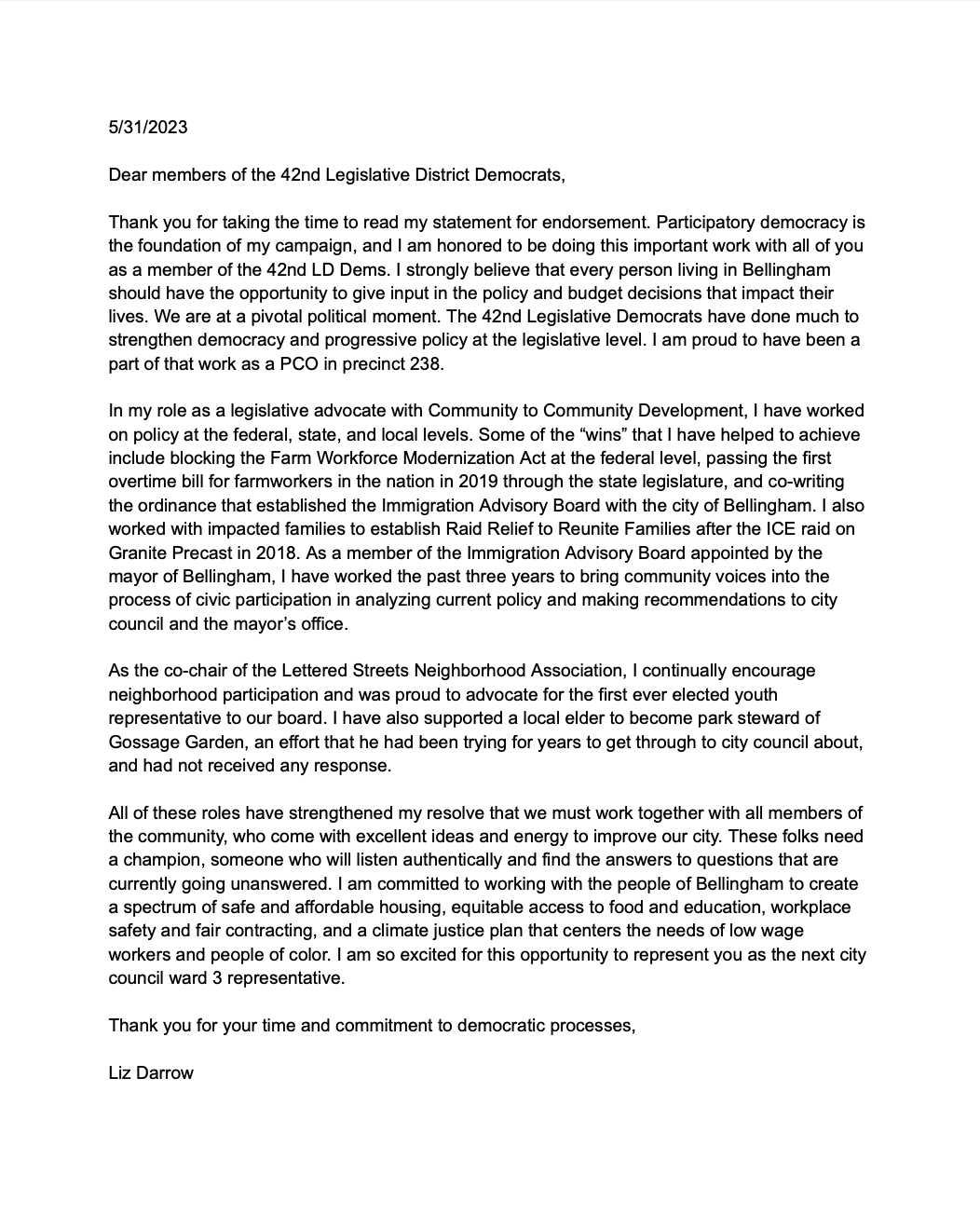
Hi Liz. You are running for Bellingham City Council for the Ward 3 seat – and this month you received the endorsement for that position from the 42nd Legislative District Democrats – so congratulations! That is not an easy accomplishment when you are running for a government office for the first time, and especially when there is an incumbent running for that seat as well.
Click the screen shot to access a PDF file of Liz Darrow’s endorsement statement for the 42nd Legislative District Democrats
What qualities are you hoping to bring to the City Council that you feel are important but aren’t currently present or maybe haven’t been present so far?
Liz:
I love this question and honestly, this campaign comes as a part of a long-term strategic plan for community that has been left out, and that includes people who I work for and with – immigrants and farmworkers – it also includes low income workers, tenants, youth, incarcerated people. I mean, the slice of pie that’s getting attention right now from City government is very, very slim.
“But I believe we have a political moment that is ready for that and so that’s super exciting. It’s more than just a person running for office. It’s a community mandate to shift the way that we treat each other. So I love that. I’m so here for it.”
And so, I think that’s why we have a political moment right now where the conventional tactics aren’t really working any more because so many people are squeezed out of being able to – you know, if they’re surviving, they’re certainly not living a vibrant life and what I want for our community is for everyone to have the opportunity to live a vibrant life. So that means that your needs are met, and that you have some left over of your resources and energy to do the things that you love. And that’s where art and music and food and all the good things about a community come from.
So I am pleasantly surprised, and I’m humbled that an organization like the 42nd legislative dems would see that because it’s very unusual for an establishment political organization to break with an incumbent. And that’s why, when people who I respect and am happy to work with in this quest for better governance – for more transparent and accessible city governance – when they tell me what to do with good intention – because there’s been a way to win. All my life there’s been a way to win, and what I am doing isn’t it.
But I believe we have a political moment that is ready for that and so that’s super exciting. It’s more than just a person running for office. It’s a community mandate to shift the way that we treat each other. So I love that. I’m so here for it.
And already, I filed in January – which is not the way you win, people will tell you that: “don’t file so early” – but I wanted a marathon. I didn’t want a sprint, because actually in organizing ten months is no time at all. So the framework for me is getting to know all the issues I haven’t been lucky enough to be a part of, in ten months.
So we’re half way through that now, about five months to go, and I know more about the Port, and what people want from their sidewalks, and those kinds of things that a candidate needs to understand more than just I want to see happen. I need to see what all of Bellingham wants to see happen, and in the 42nd legislative district, and that includes the County too. So you and Sandy get to be a part of that. It’s very cool.
And that’s why – I’ve had seven Peoples Movement Assemblies, seven events in the community so far, and I always bring a map with me and I ask people to put a colored sticker where they live, because that, to me, informs who in the community have I committed to and I need to check back in with them after I’m in office. And we also have a big long butcher paper that asks people to say, what does a healthy and safe neighborhood look like to you and that is the platform.
It’s a living thing and it’s growing, but there’s themes. People want open community spaces that you don’t have to spend money to be there. They want safety in a way that is like a knowledge of your neighbors and what will happen – predictability. So streetlights are part of that. There’s a lot of elements of safety that don’t come from policing.
And fear, fear is a really great motivator and we see that in this campaign. I feel like fear is being used to get people to behave a certain way and to give over budget decisions that they maybe wouldn’t make if it weren’t for fear.
Hope is also a great motivator, so it is this sort of epic duel between fear and hope, and I think what we’re seeing with things like the dems endorsement –
You know the Young Democrats of Western Washington University also endorsed me. That’s not as surprising because we are definitely on the same page, young people have no reason not to hope, they’ve got time on their side, so those are the people I want to be working with because they can finish the work after I’m done. They can carry it on.
But for an older established group to say ‘I think this might work,’ that makes it true. So it’s magical. I totally love it. It’s fun. I’m having a really good time. And that surprises me because I thought it must not be fun because nobody seems like they’re having fun doing it.
But I’m having fun so far and I hope – you know we don’t know yet who the team is going to be. We have a wild sort of primary coming our way. I hope there’s some people who want to have fun that come through because that – wouldn’t it be cool if we got the feeling that City Council – that people wanted to be there. That would be amazing.
Dena:
I don’t know if it was in 2017 that we first met in person, but it was during that timing that I most clearly remember meeting you during Dignity Vigils that were being held at Bellingham City Hall and a couple other locations downtown. As I recall, you were involved with the Lettered Streets Neighborhood Association at that time. Obviously, when you are interacting with a group, it’s a situation where you have to come to agreements on taking actions, even if you are just learning things together, let alone planning events, or making decisions on any rules or expectations.
Can you give me an idea of what value you recognize and personal strengths you’ve developed from participating in that particular organized community setting?
Liz:
Yes, and I also want to say, I remember the first time I ever heard you speak was when the coal terminal debate was happening at the County Council. And I want to say that was 2015? or 16. It was awhile ago. And I remember thinking – I didn’t know that you do that for every issue. You are in the spaces, saying the things. You’re really, really good at that. I just thought, wow, what a force for good. You’re speaking to this well of people with so much clarity and grace. So that’s where I was like, oh, I want to be friends with that person. So, I’m glad that we are now. [laughter] I’m glad that we know each other in a deeper context now.
The Lettered Streets Neighborhood – you know, I joined that board when my kids were small. We were at an ice cream social about nine years ago and there was a – the Bearcat was there, the Sheriff’s – is that what it’s called? It’s like a tank but it’s not literally a tank. It’s like a tactical vehicle with a gun on top. And there were kids crawling all over it. And a friend of mine, who is not white, had a small child and he was terrified. And he said, “we have to go.”
“So that was a long way of just saying I do respect the people on the board who probably don’t want to see me win because our values are so different. But they’re doing a thing with their free time, of trying to engage in like, how do we make this the way that we want it? So that’s what we have in common.”
I think my husband went and got him ice cream. He couldn’t go near it. And I wasn’t a part of the board at that time, so I went to the next meeting, and I said “we have to keep the police out of our ice cream socials. That was such a display of aggression that some of our neighbors were afraid.” And so then they asked me to join the board. And that was when Shemaia Kountouros was the board chair. They’re wonderful. I love them. They’re still in the neighborhood, but they are no longer on the board.
So the intention was not to say – this was long before any of the rhetoric of the summer of 2020, when people spoke more loudly about police brutality. And I think it’s a bummer that that energy has simmered down in Bellingham. There was a strong energy in 2020. But this was long before that and it was – the intention was not to say we can’t have police at our meetings, because the police station was in the Lettered Streets neighborhood – we can’t have weapons at our meetings. So if police wanted to come as civilians who work here, everyone who lives and works here is welcome. The safety part of it is what really matters to me as a person who lives here.
So that was the beginning of a long road. I think I’ve been re-elected now 4 times or something. The big secret about neighborhood associations that you might not know though, is that it’s hard to get people to do it, kind of like the PTA. I also was the president of two different PTAs, not because I’m the best at PTA, but because nobody else wanted to do it. [laughter] So we have to take that with a grain of salt.
This year Tara Villalba joined as a co-chair. Nobody wants to do the work of getting an active neighborhood board moving forward. It’s hard work. In a neighborhood like the lettered streets, we have houseless folks, we have tenants, we have homeowners, we have elders. The range of issues kind of is a mini model of what the City faces. But we all have in common some places, like the parks that we love.
So this year – this last year in 2022, when the Mission was getting approval to rebuild, that was a really contentious issue in our neighborhood. And some people joined the board because they wanted to push back on that. And I think the conversation was valid.
The framework though is, this is all – I mean, this is part of what I think we want to change, is when the City government says to us, “this is all you can have.” And then we have to be grateful for it, that’s what happened with the Mission. It’s all we can have. And we have unhoused neighbors and so to try to block it would be this kind of fight that it wasn’t going to work in the favor of houseless people. And as it is, it’s going to be years I think. I mean, there’s nothing there now where our Mission once stood. And that’s a problem.
And we need to open a conversation about what are the options for people who can’t go to Base Camp or the Mission. That’s been an ongoing conversation that I’ve been part of for seven years.
But there’s a park. It’s not legally a park. It’s an empty lot that I’ve been eating lunch in for 24 years. We call it Apple Tree Park. That is a place that is so beloved in our neighborhood. People sled there. People take their prom pictures there. It’s the Place of our neighborhood that – I’ve never met anyone who doesn’t love Apple Tree Park. So, that’s the place, where when I’m getting into it with a neighbor who doesn’t want what’s happening – and that’s valid – it’s going to happen no matter what – first of all, we have to be honest about how much power does a neighborhood association have. The City is going to do what the City does. And we can give input but it’s the same as any other space and we say “we don’t want this” and they do it anyway.
But the park is – and there are many things like that, but there are things that we love about our neighborhood. The Sandwich Odyssey is the oldest restaurant in our neighborhood. And they wanted to make a code change and the neighborhood was with them because we’ve known them since their kids were little.
So there’s always a way to find agreement, I think, about things that everyone cares about.
Everyone cares about Whatcom Creek when the water is too low. We worry about the salmon getting back up the stream. So we start there. And with the Mission, if there were a way for our neighborhood to change the City’s mind, I would have spent more energy there. But by the time you get the letter in the mail, it’s already done. You know? And I want to interact to change that because I think people are running out of energy to give feedback because it’s not working.
For my neighborhood, what’s important is that the people on the board with whom I disagree feel respected and they feel heard, and because I’m in a position of power in that space, people do get angry with me. And they may not want what I want.
But organizing is about setting priorities we all agree on. And so that’s really hard. But nobody wants people to die this winter in our neighborhood. We don’t want that. It’s sad. And it’s messy because then we talk about how to fix it and everyone has different ideas about how to spend those resources. But if neighborhoods could decide for themselves, I think we would probably have a more robust – we might even have a tiny home village here. I’m not sure.
But what people didn’t want was a mega-church, and that was the only thing that the City was going to offer us. So, I like to acknowledge out loud – and I’m not sure, once I’m a City Councilor that I’ll be allowed to do that, I need to read the rules – just to say that we didn’t have a choice and we were upset by that. That’s true. And I’m upset by that too. And, if that’s the only place where lives can be saved, we need that too.
I’m not excited about a 50 foot cross being the thing that welcomes people to our neighborhood. That’s not the values of the people who live here, you know.
So that was a long way of just saying I do respect the people on the board who probably don’t want to see me win because our values are so different. But they’re doing a thing with their free time, of trying to engage in like, how do we make this the way that we want it? So that’s what we have in common.
Dena:
One way I’ve enjoyed getting to learn more about you is from your questions and conversations during broadcasts/podcasts on the Community Voz show that airs on our local public radio station KRME FM. From that, it’s easy to get a sense that you are someone who is inquisitive, and a good listener. You’re able to take things people say and plug them into current and past situations in a way that leads to everybody being able to meaningfully reflect on those and develop their ideas about things. And it also seems you can get a real sense that you are invested in, and unafraid of exploring a wide variety of different movements, cultures, and counter cultures that exist within our community, and in others around the world. Meanwhile, your position with Community to Community Development, which is an organization that really encompasses all those qualities as well, is that of Legislative Advocate.
What would you say are a couple ways your learning experiences are helping your efforts to drive legislative actions and successes that can end up providing wellbeing and empowering the community members of whom those movements and cultures are composed?
Liz:
Yes, I am so lucky to have the job that I have. I really, really love it. And part of what’s so good about it is learning about all these democratic processes that are open to participation from the public. I think our state legislature does that really well. I mean, they have lobby days, but you also can schedule anytime during the session. And it’s kind of funny, I learned recently that the Washington State [legislative] session is set because of agriculture schedules. It’s always set in the winter because it used to be that farmers were given priority in that space, which doesn’t surprise me, knowing what I know, but that’s why we have a winter session.
“And so the way to get to that place is to show up and be humble and listen, and not to start with your own ideas about how other people should conduct their lives or what policy would be good for a group of people whose life experience you don’t have, but just to be curious and listen.”
So learning from people like John McCoy and Karen Keiser that if you come with a busload of people who are experiencing something that the representative you are talking to has never experienced, and they sit with you and they take notes and they receive you with dignity, you kind of know that there’s a relationship there that you can rely on, that you can call on when something like the death of a farmworker happens, because you know that they’re with you.
What I’ve learned from being a legislative advocate is how to demonstrate that I have the backs of the people who are with me, so much so that they’ll trust me to drive them in a winter storm down I-5. [Laugher] That’s a big deal!
And so the way to get to that place is to show up and be humble and listen, and not to start with your own ideas about how other people should conduct their lives or what policy would be good for a group of people whose life experience you don’t have, but just to be curious and listen.
And then check back in, so there’s like – I say that participatory democracy is a revolving door because the job is not done once you’re elected. You need to maintain that relationship over time, which, I’ll admit, I think that can be tricky. It takes a lot of energy to keep checking in with people and you have to wait.
So you can’t be like the big hero like so many people seem to want to do [laughter] because it’s a collaborative process. So I’ve learned that, you know, one person doesn’t take credit for the work of a community because it truly is – democracy really is a group project.
I’ve learned how to work with people and that means like working with people in power, but also working with community. That’s the most important part of the work, I think. It’s like finding out how to be there for people in a genuine way, so that when they need something they won’t be afraid to ask and they also will trust that you’re going to do something with that information.
Dena:
I know some of your work with the team at Community to Community Development helped bring forth the first Bellingham City government advisory board related to immigrants and immigration to address the needs and struggles that they have with being included and valued for their culture and work, and to prevent them being targeted with criminalization and other mistreatment that sometimes results government actions that takes them from their families and jails and deports them. You have been serving on that board for a few years now.
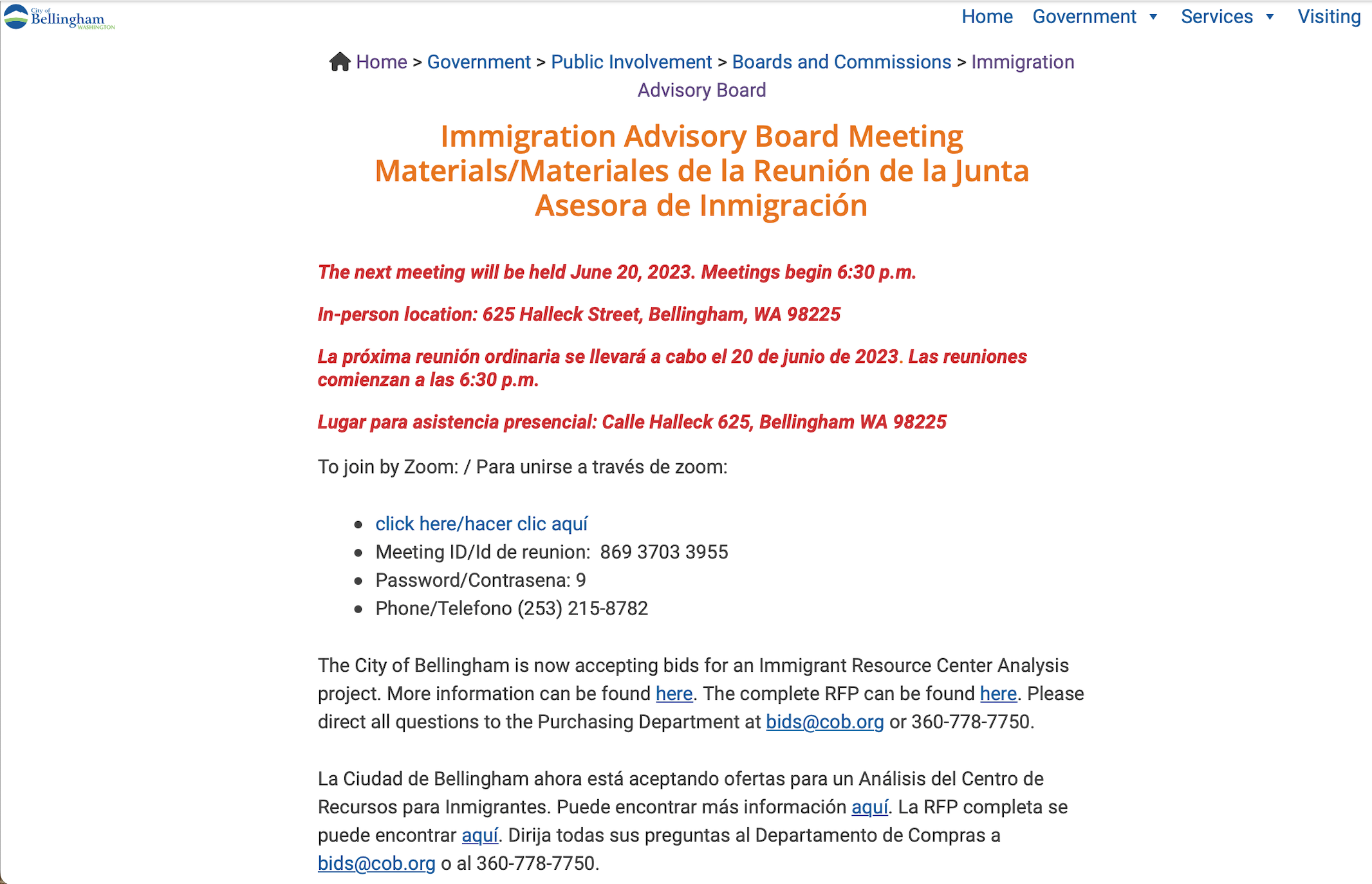
Click the screenshot to access City of Bellingham Immigration Advisory Board information and meeting materials
What is most hopeful and encouraging to you about the work you see that board doing and what is the most challenging barrier to accomplishing policies and resources that will help address and prevent crises, mistreatment, and trauma for immigrants in our community?
Liz:
Well, we’ll start with the good part. So, what is most hopeful? When the board started – we became a board in November or December of 2019, but we didn’t actually meet until June of 2020. And that was because the pandemic happened right at the beginning of that board. We had to figure some things out.
“It’s such a cool thing to witness, because there has to be a way. And so if you have a group of people who don’t want to take no for an answer, but they’ll hear a ‘no, and’ – like, ‘you can’t do it right now, but here’s the way you could get it done.’ I mean, there’s a will on the part of the board to keep moving, which is very cool to see. “
So the first time we met on Zoom was the first time that I met any of the people who were in the first iteration of the board. And I believe that 10 of the 12 of us were white English speakers. And that really surprised me to see that because we knew that many people of color who were not English speakers had applied.
So that was our first sort of mandate, to face the reality that the City of Bellingham governing structure is not a welcoming place for immigrants. No matter what we say, what we’re doing is making more space in places of power and influence for white, English-speaking people.
So, I’ve been on the board for three years. I have one more term that starts this month for my last two-year term. I will be the last person from that first crop of people, because people move, and have children, and things happen. But now the board is a majority of members who are immigrants and who have a first language that isn’t English.
So that, to me, is the biggest indicator that what we’re doing is working for immigrants, because right now we have several openings on the board. We also have six different applications pending, and all of those folks are either immigrants themselves or their family is impacted by decisions we make for immigrant people without immigrant people.
We have language diversity, we have – since 2018, which is before the immigration advisory board, but one of the things that inspired us to create the Immigration Advisory Board was the raid on Granite Precast which lead to 18 people being detained by ICE. And during the processes of going to County Council and asking for better protection, because the County Health Board had an interest in this at that time through the Public Health Access Board which I was on, they had headphones at County Council where the people who didn’t speak English could listen in their own language. That was five years ago, so we’ve been saying to the City ever since, “There’s a way for people to access language without it being consecutive [where statements are made in one language and then are restated in another language] because our meetings are really long and part of that is because people need to be able to understand what’s going on if they don’t speak English.
So just finally, I believe last month, the City got their own headphones. That took five years. And that was something that was really frustrating the whole time we were asking for it because it took a lot of time from our meetings to say, “How’s it going with getting headphones?” for five years. And the staff person who was assisting us moved on. We got a new staff person and we had to start over. And same with the Council. We had a Council liaison who left. And we got a new Council person who had no context. So the processes have been so clumsy.
But those two things, having a board that matches the title of the board and also the intention and then having language access finally for – I don’t know how many languages could be accessed through those headphones, I need to find out, but at least Spanish, and that’s the majority language of the immigrants who participate.
So I see those as the very best indicators that we’re getting somewhere.
The thing that has been hard is that no one on the board currently – this might not have been true with the first group – but no one who is currently has the privilege of access to government spaces from a professionalized standpoint and so we are all volunteers in the space, and we are all trying to figure out wha the rules are and there is no other board like the Immigration Advisory Board because we want the board to be community-led and formed.
And so when we have come to the City with lots and lots of testimony from the community, research and input from other cities about how they do best practices – for example, like with an immigrant resource center – and then it has been frustrating and surprising over the past three years. And we can do what we think is good process and then the City says, “No, that’s not the way to do it.” And then we feel stuck. But even within that, there’s always a way to move forward but we just need the City staff to be willing to work with us.
So that has been frustrating because it hasn’t felt like a priority when we’re in that space. It hasn’t felt like the City is motivated to participate and move forward with us. And I think that will change. We just found out the City Administrator left, so, again, we’ll have a new person. We don’t know who they will be. We want to have some input as a board into who – actually the city administrator has more power over what we do than the mayor. And I think that has to do with who the people are. I don’t think that is in the charter.
Now that we see that we have an opportunity for a new mayor, a new city administrator, and a couple of new Council people, that will change the work and I hope it changes for the better. But we’re also trying to – all the people on the board have full-time other jobs and we’re trying to understand a whole City’s worth of process just to get something done for immigrant community members and their families because, like all people, they’re having a whole civic life here, and so it isn’t just about citizenship or naturalization, it’s about how to have a life here and that needs to be available to all people who live here. So it’s pretty basic, but it is an ask that the City has never addressed before. So that’s a challenge.
And I think it’s going well, even though from the outside it looks like, oh, this is taking forever. But, you know, it takes time, change takes time. We’re moving at the speed of trust in some ways, and that’s something we have to build from scratch because we haven’t ever had trust with the community, basically.
It’s wonderful to be a part of it. It’s such a cool thing to witness because there has to be a way. And so if you have a group of people who don’t want to take no for an answer, but they’ll hear a “no, and” – like, “you can’t do it right now, but here’s the way you could get it done.” I mean, there’s a will on the part of the board to keep moving, which is very cool to see.
Dena:
Where can people find out more about you and your campaign for Bellingham City Council’s Ward 3 position? What’s the best way for folks to contact you if they would like to donate or volunteer?
And I have an office, and this was something that’s really amazing to me. When I am in City Council, I will keep my office. It’s downtown.
It’s on Holly Street. 203 West Holly Street, #328.
And I want people to come and see me at my office and participate in – like I told you about the mapping activity and the butcher paper input – I want people to talk to me about what’s going on in their neighborhood. I also know that when you’re asking people to come to you, you’re not getting a realistic sampling, because people have to work and they have transportation issues. And so I plan to be out in the community every chance I get, but if people want to, they’re certainly welcome to email me or come find me at my office.
There’s an input form too, [at the bottom of the home page] on the website, so that’s like – ways that are accessible for people to reach out and tell me what their priorities are.
Dena:
Do you have any regular hours or days that you might be at your office or is that just random, possibly?
Liz:
Well, so far it’s been random because it’s endorsement season and so, like today, I drove down to Everett for an endorsement interview and I wasn’t at my office. But I think endorsement season ends in June, so starting July first, I’m going to be in my office from 9:00 – 3:00, Tuesday and Thursday, for sure.
At this point, I would just encourage people to email me because the way it’s going right now, everybody wants to get coffee and that’s great, but I drink a lot of coffee. [laughter] I’d much prefer to sit down in my office or go for a walk. I like to walk around and work too and talk about what’s possible. I think the best way right now to coordinate with me is through the website or email.
Dena:
Also, if people would like to donate or volunteer, can they do that through your website, as well?
Liz:
Yes, so on the home page there, there’s tabs to the right. There’s a “Volunteer” tab. There’s a “Donate” tab. There’s an “Endorsement” tab, and I’m working on getting an “add your name” so that people can endorse, if they want.
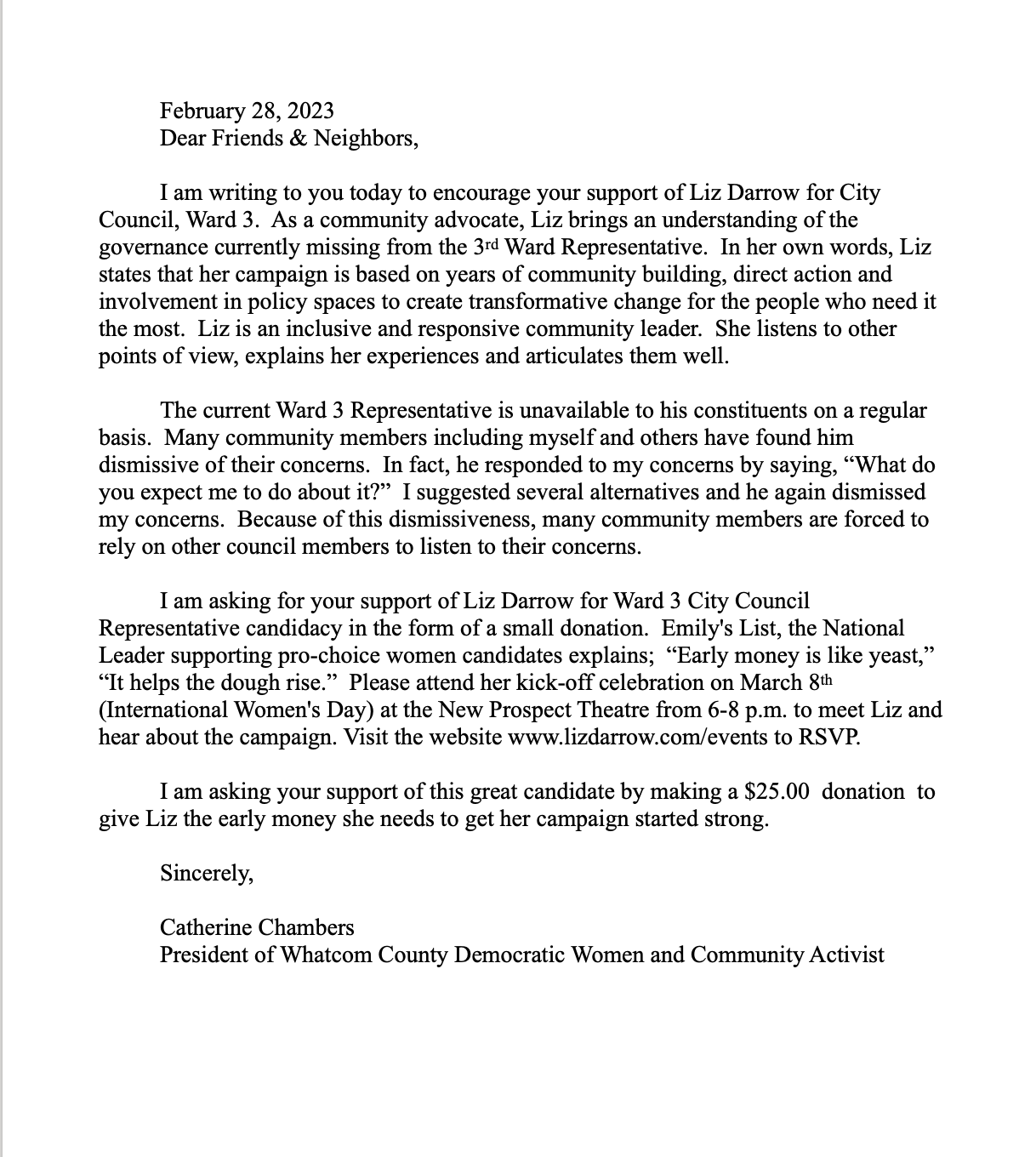
Click the image to access a pdf file of a letter from Whatcom County Democratic Women President Catherine Chambers supporting Liz Darrow for Bellingham City Council Ward 3




 noisy waters northwest
You must be logged in to post a comment.