

July 26, 2023 Dena Jensen
Last month a number of local political organizations were engaging with candidates running for office in the November 2023 election who were seeking those groups’ endorsements. On June 10, I attended the meeting of the 42nd Legislative District Democrats to hear the statements of those candidates who were present.
Something stood out to me from remarks made by current Bellingham City Council Member Dan Hammill, who is running for the Ward 3 position he currently occupies, in competition with Liz Darrow who is also running for that seat.
During the meeting, I thought I had heard Hammill point out that civic public comment was a way he engaged with the community. But I don’t have a recording of that, so I can’t be sure.
I had been fairly closely following the City Council’s various restrictions of open session public comment during the past three pandemic years, a period when the Whatcom County Council chose not to restrict theirs.
Since attending the 42n LD Democrats pre-primary endorsement meeting, the Riveters Collective has posted their endorsement interviews on YouTube, which they also had conducted in June, and I heard Hammill refer to public comment as a way he planned to involve residents in the City’s decision-making process:
Beth Hartsoch :
“Question Number 2: How do you plan to involve residents in the city’s decision making process?”
Initially, Hammill responded that he’s served on over 30 boards, commissions, and task forces for the City and that he voted to remove the requirement to be a citizen to serve on boards and commissions, so anyone residing in the City would have the potential to serve. He went on to say that he intends to keep listening to those voices. One of the boards where those voices are speaking is the City of Bellingham’s Immigration Advisory Board meetings. Meeting minutes do not reflect that Council Member Hammill has attended any of those meetings over the three years it has been in existence.
After that he stated:
“You know, every two weeks we have public comment at Bellingham City Council. We also had a public hearing this last Monday and we continue to hear those voices. I strongly support the Engage Bellingham component of our website and I have meetings with constituents on a very regular basis.”
Again, this remark about public comment stood out to me. Related to the question Hammill was asked, I knew the answer indicating that he would be planning to involve people in City decisions with public comment at City Council meetings was in pretty strong opposition to views which he had expressed and City Council action he had taken before this election year started.
In the earlier pandemic and post-January 28 sweep months and years during 2021 and 2022, the Bellingham City Council, first, began strictly limiting public comment at their meetings to 15 minutes, and then completely stopped making video recordings of open session public comment and separated it from their meetings, eventually shutting it down completely for virtually all of 2022.
That year of 2022, the Council opted to offer four two-hour Town Hall meetings which were structured like public hearings, each with a prescribed topic, along with additionally specific questions they posed for community members to answer during the meetings. Speaking time was reduced from the standard three minutes to two minutes per person.
Prior to that arrangement being put in place though, at the end of August of 2021, these were the notes from a segment of the City Council’s Committee of the Whole meeting:
“Council President Stone opened the discussion for exploring new opportunities for public engagement. She proposed a separate time for Council to host public comment. Discussion on hosting a two-hour public comment period during the City Council regular meeting or a town hall type of meeting in a particular neighborhood was proposed. Her proposal is that it would not be recorded. Unless it is a Public Hearing. By law, Public Hearings must include recordings of comments.
“Michael Lilliquist / Lisa Anderson moved to try a virtual public comment period on an off-meeting day as outlined in the attached memo of the agenda.
“MOTION CARRIED 7-0”
However, the vote that was documented in the meeting minutes is in error. In the meeting recording reflecting the discussion of public comment and the motion by Council Member Lilliquist that was made, Council Member Hammill made the comment below and was the sole “no” vote on the motion:
“Yeah, I’m not interested in either one of these options, quite frankly. The level of toxicity that we’ve experienced – I feel like I’m in an alternate reality right now, that we are even having this discussion. The level of toxicity that we’ve all received that’s in our homes, with our partners, our spouses, the things that were directed at us, that were wholly not supported and not true and then the subsequent high-jacking of the anti-scientific folks who have threatened the loss of our YouTube access now. I don’t know why we would invite more of this. It doesn’t make any sense to me to do that.”
The vote on the recording is at this link: https://youtu.be/w58y7Hv6BxU?t=2858
As someone who was regularly watching the public comment sessions at the beginning of 2021, I can trace Council Member Hammill’s perception of toxicity related to public comment to only an extremely small minority of comments. These came from a handful of folks not able to contain their state of turmoil, with almost all of these few people speaking during the public comment period on January 25, 2021 when the deep-winter sweep of around 100 people without shelter staying at the tent encampment, Camp 210 – established in early November 2020 and adjacent to City Hall – had been announced and was imminent.
The following paragraph is from a Facebook post I had made on January 31, 2021:
“At the 1/25/21 Bellingham City Council meeting, 36 people offered public comment and 5 to 6 (is ‘damn’ still profanity these days?) of those 36 comments contained the use of profanity. In 2 of the 6 comments the swearing was derogatory toward the Council at the close of the 2 comments.”
Here is a link to a blog post project that includes transcriptions of the public comments that were given from January 11, 2021 through March 8, 2021: https://noisywatersnw.com/2021/09/04/bellingham-city-council-public-comment-transcription-project-january-11-2021-through-march-8-2021-noisy-waters-northwest/. Readers can assess for themselves any level of the toxicity that Council Member Hammill referenced in his August 2021 comment objecting to offering public comment based on past sessions.
It was after March 8, 2021 when the Council began enforcing a strict 15 minute time limit for open session public comment. Of the roughly five speakers who could be heard in that amount of time at each meeting, often a majority of that small number who were chosen to give comment were voicing objections to COVID-19 vaccines and COVID-related mandates.
Meanwhile, after the August 30, 2021 vote of approval by all the other City Council Members except Council Member Hammill, the special public comment meetings began occurring on the City Council’s off-meeting weeks.
The meetings were never recorded, but here is a link to a City of Bellingham webpage where minutes of all the Special Public Comment Meetings were provided by the Council President at that time, Hannah Stone: https://meetings.cob.org/Meetings/Search?dropid=11&mtids=103&dropsv=09%2F01%2F2021%2000%3A00%3A00&dropev=12%2F31%2F2021%2000%3A00%3A00
I attended all these special meetings, and while the balance of comments was tipped heavily to COVID-related topics, the remarks were virtually all distinct from one another and there was definitely still a mix of topics raised at the meetings.
As much as I disagreed with almost all of the points raised by those speaking against the emergency COVID-19 protections enacted by state and local governments, I also learned a lot about what information various community members were being exposed to and trying to amplify. Speakers shared their sources very often, so I was able to fact-check and find out how and from where the narratives they were sharing were being spread.
The meetings were open to anyone, and therefore there was potential for community members to show up to voice their support of COVID-19 mandates and vaccinations or any other topics about which they wished to speak. And some did.
From the meeting minutes there is documentation that Council Member Hammill was never present at any of those meetings. The only other Council Member who was also never listed in attendance was Gene Knutson. Here is the link to that webpage with the minutes for those meetings: https://meetings.cob.org/Meetings/Search?dropid=11&mtids=103&dropsv=09%2F01%2F2021%2000%3A00%3A00&dropev=12%2F31%2F2021%2000%3A00%3A00
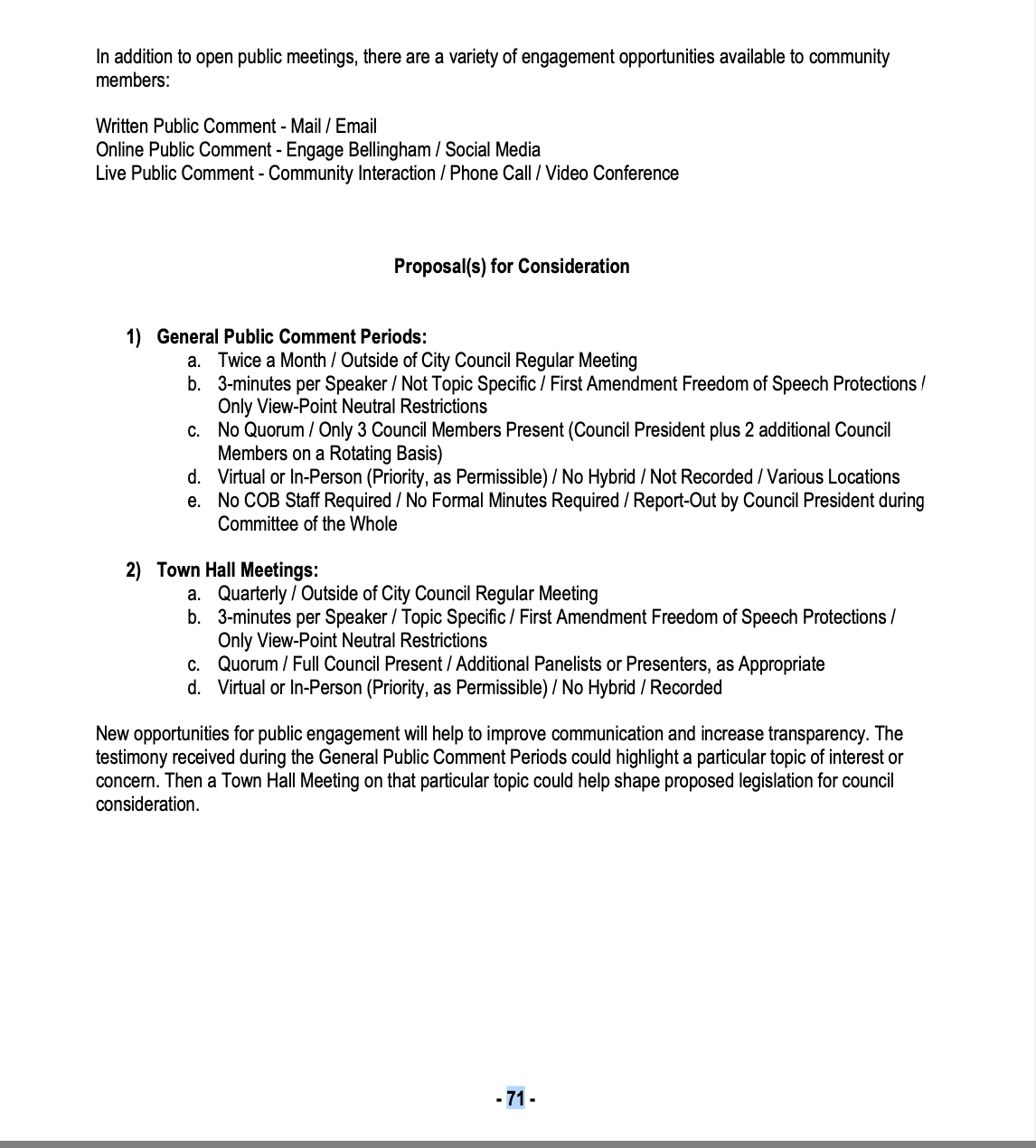
During the City Council’s January 1, 2022 re-organization meeting, the topic of a plan for public engagement that involved public comment once again came up for a vote, with Council Member Lilliquist moving to support Council President Stone and staff to develop quarterly or semi-quarterly town hall meetings.
Prior to the motion, Council President Stone sought to clarify if the preferences voiced by Council Members for the town hall concept would be instead of standard public comment at Council meetings, or in addition to it.
Council Member Hammill reponded:
“ I just want to make it clear that this is not some kind of attempt to stifle public input. If you look at the top of the page of packet page 71, two of the three methods of gaining – for the public to gain access and to engage, are not public comment. They are – one is written: email, and the other is using the Engage Bellingham website. And so there’s plenty of ways for the public to engage.”
Months after the August 30, 2021 meeting, Hammill’s main emphasis related to his opposition to public comment during this January 3, 2023 meeting was by that time specific to hearing people deliver material he found to be untrue about COVID-19.
Council Member Hammill did not mention that in the cases of submitting comments through email and Engage Bellingham, it is often prohibitive for community members to know if Council Members ever read those communications.
Additionally, there is a much reduced potential for commenters to know that their community is aware that they have commented and what they have said compared to that potential when community members make oral comments at recorded public meetings. When Council Members do not attend meetings where public comment is held, the community has the ability to note that absence.
Since the beginning of 2023, the Bellingham City Council began offering a 30 minute open public comment session at their meetings again, moving it from a previous timing near the beginning of their meetings to the very end of their meetings, after Council Member decisions have already been made and City business is complete for the evening. The recordings of these comment sessions are separate from those of the other part of City Council meetings. People who are not attending in person, have to attend through Zoom or by phone in order to offer their comments.
Much of the time I spend on public matters often involves looking at the actions of elected leaders related to justice issues in Whatcom County during this time when many of those leaders are voicing support of equity and inclusion, along with trauma-informed and deescalation responses to those who have been and continue to be marginalized or are in a state of crisis.
I have found that most leaders will at least struggle periodically in public meetings with exemplifying these approaches to their fellow community members who make the effort to offer public comment, many of whom at any given time could be experiencing discrimination or desperation and be in critical need of compassionate responses from those in positions of power.
It’s been my experience that some elected officials have a harder time than others practicing what they profess, sometimes to the degree where their failure to meaningfully include and be accepting of certain community members becomes oppressive.
At times, this can lead to me wanting to question the validity of other claims they make about measures they support and lead.
 noisy waters northwest
You must be logged in to post a comment.