
September 17, 2023 Dena Jensen
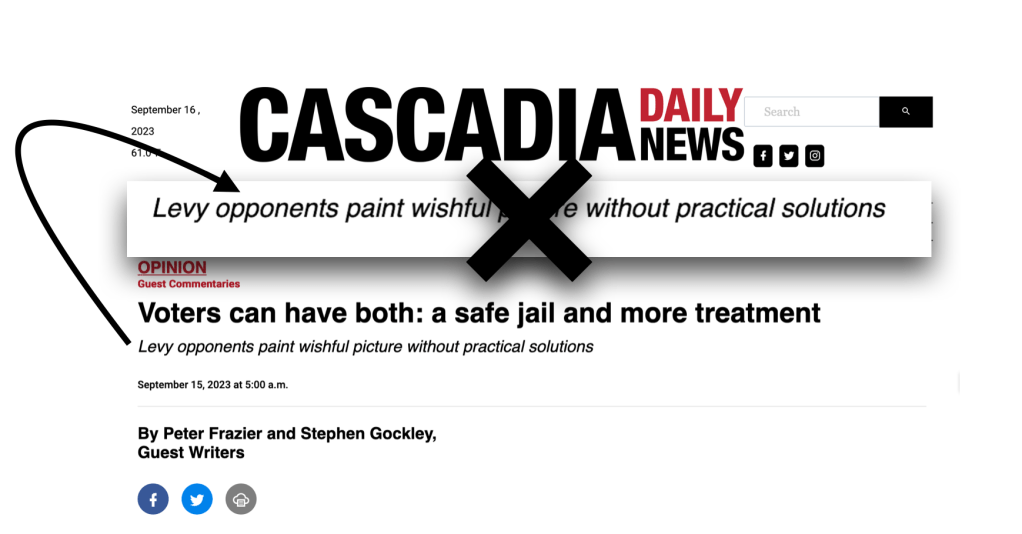
It’s unfortunate and disappointing that ballot measure sales tax proponents Peter Frazier and Stephen Gockley are making some misleading and inaccurate assertions such as the ones below from sections of their September 15, 2023 guest commentary, “Voters can have both: a safe jail and more treatment,” in Cascadia Daily News:
“Levy opponents paint a wishful picture without practical solutions. Their treatment-but-not-jail approach offers no answers for handling the high-risk individuals now in jail. They provide no guidance for expanding treatment capacity quickly or building facilities for new services. They discount concerns of many residents regarding the effects of growing misdemeanor crimes.
“These effects are accelerated by booking restrictions and have profound impacts on community livability. If we vote ‘no’ as they want, we’ll consign thousands more to an overcrowded, unhealthy and unsafe jail with inadequate treatment resources for years to come.”
Within Whatcom County there are many community members with a variety of positions driving their opposition to the November sales tax measure that will solely fund a new jail for the first 4-6 years of its 30 year life-span. Proposed services and treatment options are relegated to no less than 50% of what’s left over after that time, if the ordinance for the tax measure is adhered to. Of these opponents, many have also put forward practical and realistic solutions to help address our community’s needs for increased health and safety.
In the September 1, 2023 guest commentary by Andrew Reding, Chair of the Whatcom Democrats, entitled, “Costs, incarceration rates merit a ‘no’ vote on jail measure,” which Frazier and Gockley link to as having unrealistic “alternatives”, numerous practical and realistic solutions are described. Reding’s commentary points to addressing the urgent need for increased housing that’s within reach of all community members and taking actions to reduce or replace bail, which are measures that are actually included in Whatcom County’s Justice Project Implementation Plan.
Far from a “treatment-but-not-jail” approach, a resolution of the Whatcom Democrats was nearly unanimously approved this summer which provided considerable detail on the element of following best practices that have not yet been followed in the pursuit of a new jail facility.
Certainly, the four members of the Incarceration Prevention and Reduction Task Force (IPRTF) who voted against the Justice Project Implementation Plan were people who offered many practical suggestions and contributions to numerous of the 14 out of 15 non-jail projects that are now part of the that implementation plan, most of which are not slated to receive funds from the sales tax. The 23 hour Crisis Relief Center was one of those, having already received $9 million from Washington State. Three of these IPRTF members spoke out during the meeting prior to their vote as shown in the summary from the meeting:
- “Jason McGill said that the plan put forward is opposite the recommendations put forth by those with lived experience and the BIPOC communities who shared their input.”
- “Heather Flaherty said the draft plan provides a strong framework of projects, but she feels it still requires work.”
- “Arlene Feld said that she feels strongly about increasing access to services, and she feels the draft prioritizes construction of the jail over behavioral health services.”
- “McGill said he is passionate about increasing access to behavioral health services as well and wants to see the plan go further in supporting and providing those services. He said more young people needed to be included in the discussion and emphasized that he does not believe the plan”
Meanwhile, subsequent to that meeting, IPRTF member and Executive Director of Northwest Youth Services (NWYS), Jason McGill has been contributing significantly to “expanding treatment capacity quickly,” for example, by promoting government agencies increasing their level of investment in the Teen Court program NWYS has been running. This is not to mention the many other community services having been offered by NWYS for years that help create stability and well-being for youth in Whatcom County who are experiencing homelessness and the crises and trauma associated with it.
One opponent of the November sales tax measure, and a member of the Stakeholder Advisory Committee, Atul Deshmane called for, among other things, reviewing and revising the VERA Institute of Justice Report to Whatcom County which were measures Deshmane requested first, two years ago, and again another year later. That action was ultimately considered to be practical enough that a report was commissioned by Whatcom County to evaluate their progress on the Vera Institute report’s recommendations which is anticipated to be presented at a Whatcom County Council Committee of the Whole meeting in early to mid October.
While we need to keep pursuing it with urgency day after day and year after year, we are getting much closer to developing a system of justice that works for all of us in this community. What has consigned thousands of people in our community “to an overcrowded, unhealthy and unsafe jail with inadequate treatment resources” for many years is inadequate resources being devoted to generating community health and well-being, and above all, inadequate resources to provide ways to keep increased numbers of people from having to be placed and retained in jail.
Focused on deadlines for this November’s election, local government officials hurried hard enough with this tax ballot measure that it: makes use of a means of taxing that is one of the most discriminatory to protected classes; does not make clearly evident and binding the prioritization of services over punishment; and does not provide a detailed plan for building a jail where people could easily recognize it is going to be a size aimed at benefiting from enough imminently and amply available services to keep people in it for shorter and shorter periods, while helping keep more and more people out of it as time goes on.
In order to address such flaws, it will take our officials working consistently and meaningfully as they never have before with their community, which includes, among so many other engaged and informed people, those who are leading tours telling the history of incarceration in Whatcom County and the discrimination that has driven it.
That discrimination is presently evident to the point that during the current Justice Project process, participants reported that they did not know how to effectively reach out to marginalized communities and ultimately they had to resort to hiring a consultant to help them to bring in at least some of the views that were absent for the majority of the assessment period of Justice Project needs.
Our community also includes those looking forward and daring to imagine a future without incarceration at all. These are hardly perspectives that should be discredited as unrealistic or impractical, when it is the study of history and vision for the future which has always been essential to creating increased justice for all.
 noisy waters northwest
Pingback: Whatcom County’s 2023 pro-jail PAC lets their inaccurate allegations stand/ Noisy Waters Northwest | noisy waters northwest
Pingback: People of under-represented communities and their advocates continue in struggle for services over jail / Noisy Waters Northwest | noisy waters northwest