

October 28, 2023 Dena Jensen
It’s closing in on a year ago since Whatcom County’s Justice Project evaluated their needs assessment process according to a toolkit provided by the Local and Regional Government Alliance on Race and Equity.
On Whatcom County’s Justice Project webpage, it states in part:
“On January 26, 2023, the Stakeholder Advisory Committee (SAC) approved a motion recommending the final Justice Project Needs Assessment Report to the Whatcom County Council. The report makes recommendations for systems, services, and facilities related to public health, safety, and the criminal legal system in Whatcom County and was created with input from the SAC, the Incarceration Prevention and Reduction Task Force (IPRTF), subject matter experts, and the public.”
In their “Notes from Meeting Applying the Racial Equity Toolkit to the SAC’s Work Nov. 29, 2022,” it documented that a group of four people – two of whom were members of the Justice Project Stakeholder Advisory Committee (SAC), and two of whom were from Crossroads Consulting and had been performing facilitation services to the SAC – participated in the meeting.
Among the information provided in the notes was the acknowledgement that no people of color were participating in the Racial Equity Toolkit review that day.
Here were some other noteworthy acknowledgements provided in the review:
“Community Engagement – What community-based organizations do we need to partner with to advance racial equity in our 19 priorities? Where are the juncture points that you think engagements will be most critical?
▪️The focus on community-based organizations might be off. Different communities have different needs and preferences for engagement.
▪️How do people who aren’t part of the org. get their voices heard?
▪️Could reach out to communities of color that SAC members are affiliated with (for example, the recovery groups Teresa meets with).
- An effective way to reach out to people in substance use disorder treatment is to go through treatment providers who could encourage clients to share their perspectives.
▪️Should we get more grassroots rather than going through orgs.? How helpful will grassroots feedback be?”
The recognition that the whole Justice Project needs assessment process had been conducted with little knowledge of how to effectively engage with BIPOC and other under-represented members of the community is significant and reflects the potential of the SAC and consultants to have harmfully biased perspectives and approaches.
In turn, there is additional potential for this bias to have impacted, not only the Justice Project needs assessment process prior to the Racial Equity Toolkit review, but also the presentation of information to, and assessment of information that came from under-represented communities who participated in focus groups assembled after the review.
There is no mention in either meeting summaries for the SAC or Whatcom County Incarceration Prevention and Reduction Task Force of any other Racial Equity Toolkit reviews related to the Justice Project after the one on November 29, 2022. Therefore, actions taken related to the Justice Project after that review do not appear to have ever been evaluated according to the Government Alliance of Race and Equity toolkit.
Those in crisis and their advocates work to inform voters
Meanwhile, members of under-represented communities and their advocates have been doing their own research on issues related to public health, safety, justice, and on Whatcom County’s Justice Project. One of the products of this research is a September 2023 online zine, titled “No New Jail in Whatcom County” and created by by Fiona Martinez, Kaia Gilje, and Keara R.
Whatcom Peace and Justice Center, which has offered resources promoting health, safety and justice in our county for many years, is sharing access to the zine which presents visually engaging pages of perspectives and information to help inform community members about the history and impacts of jail in our region, especially on those who are disproportionately incarcerated, discriminated against, and who are under-represented and under-served in Whatcom County.
In one section, people who contributed to the zine shared their thoughts related to why they oppose the new Whatcom County Jail which is currently being proposed, and their connections to local communities.
Below are links to the zine and to the page of resources for the information that was provided in it:
“No New Jail in Whatcom County” –
https://www.canva.com/design/DAFvwd3i49s/_fSJzD51VYkytm0e45Ttfw/view?utm_content=DAFvwd3i49s&utm_campaign=designshare&utm_medium=link&utm_source=viewer&fbclid=IwAR0nK7DBhmmoUV_9YkxRaif2zH9Ij9K9BxOlQEJKQE9UXf5KCQpIGaqa7z0#1
Resources: No New Jail Zine –
https://docs.google.com/document/u/0/d/1pXO-F0wFXTPn7hWlNqcAWqLomRkpC0EA-DQS1JzD3Q8/mobilebasic
Priorities of under-represented participants are cast aside with officials’ approval of funding measure
In a May 2023 Whatcom County Justice Project Implementation Planning presentation, there was a section titled “Recap: Focus Group & Survey Results.”
One portion of a disclaimer in the slide presentation stated:
“Recruitment of participants prioritized people from communities that have been under-represented in the Justice Project, and whose input is essential (people with lived experience in the criminal legal system, Black, Indigenous, Latinx/Hispanic, and other people of color). People chose to participate in a focus group and survey and were paid for their time (a self-selected, non-random sample).”
When it came to the review of the survey results, a list of pre-determined actions had been presented to respondents who were asked to rate them in specific ways. In the presentation slides, the percentage of responses where the 74 respondents rated each listed action as “very important” or “important” were shown. Ratings of “somewhat important,” “not at all important,” and “don’t know” were not displayed.
Almost all actions were related to services and reducing incarceration. Only one was exclusively related to the jail, which was the action to “Build a safe & humane jail that is right-sized, well-designed, and affordable to build & operate.”
All of the service-related actions received important/very important ratings in the 90+ and 80+ percent ranges. The action to build a jail received the least responses of important/very important at 74%.

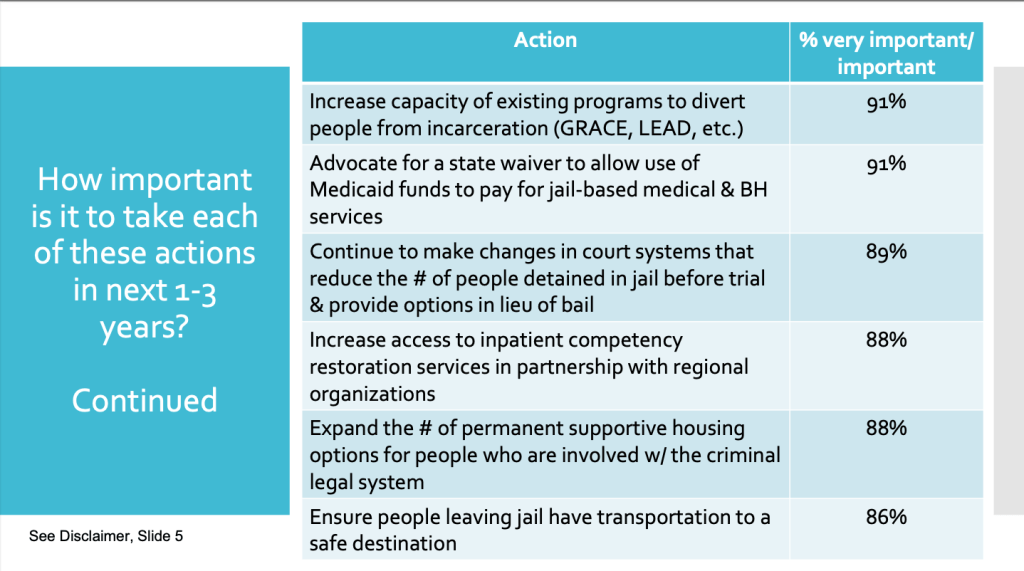
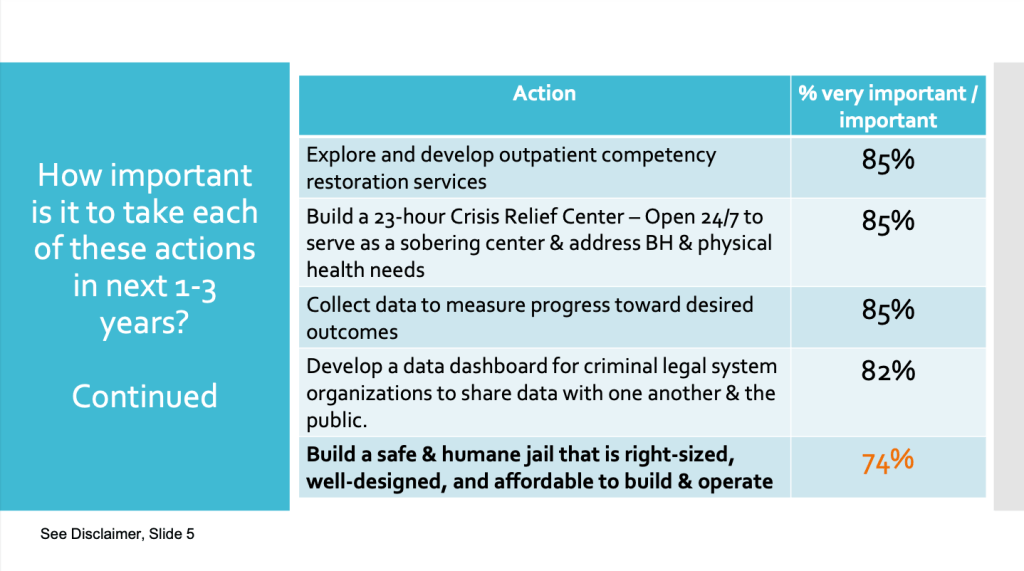
These responses contrast with a November 2023 sales tax ballot measure, the ordinance for which advances the funds first and exclusively for 4-6 years to building a virtually unplanned new jail with an even less-defined onsite behavioral health center. Just a handful of the remaining 14 recommended services and incarceration prevention actions might start to receive a minimum of 50% of funds following those years of delay. But there is nothing documented at this point which ensures the delivery of even that amount of funding for actions valued as important by considerably more survey respondents.
Many government leaders have chosen to coalesce across political parties in support of a tax that continues to incorporate discrimination in its most prominent facet. This continues to leave behind and even further marginalize organizations and individuals who have been consistently left to build their own systems and solutions to guard the safety and well-being of those who are left out and pushed out of a local circle of power, and who are also disproportionately targeted to be incarcerated.
Many people, like those who gave input through the Justice Project focus groups and survey, now continue to bond together to fend off a measure that has already been resulting in their continued mistreatment. Once our elected leaders start to bond with them in taking action, instead of with those seeking to incarcerate more people, we may begin to meaningfully gain ground on bringing forth public health, safety, and justice.
.
 noisy waters northwest

You must be logged in to post a comment.