
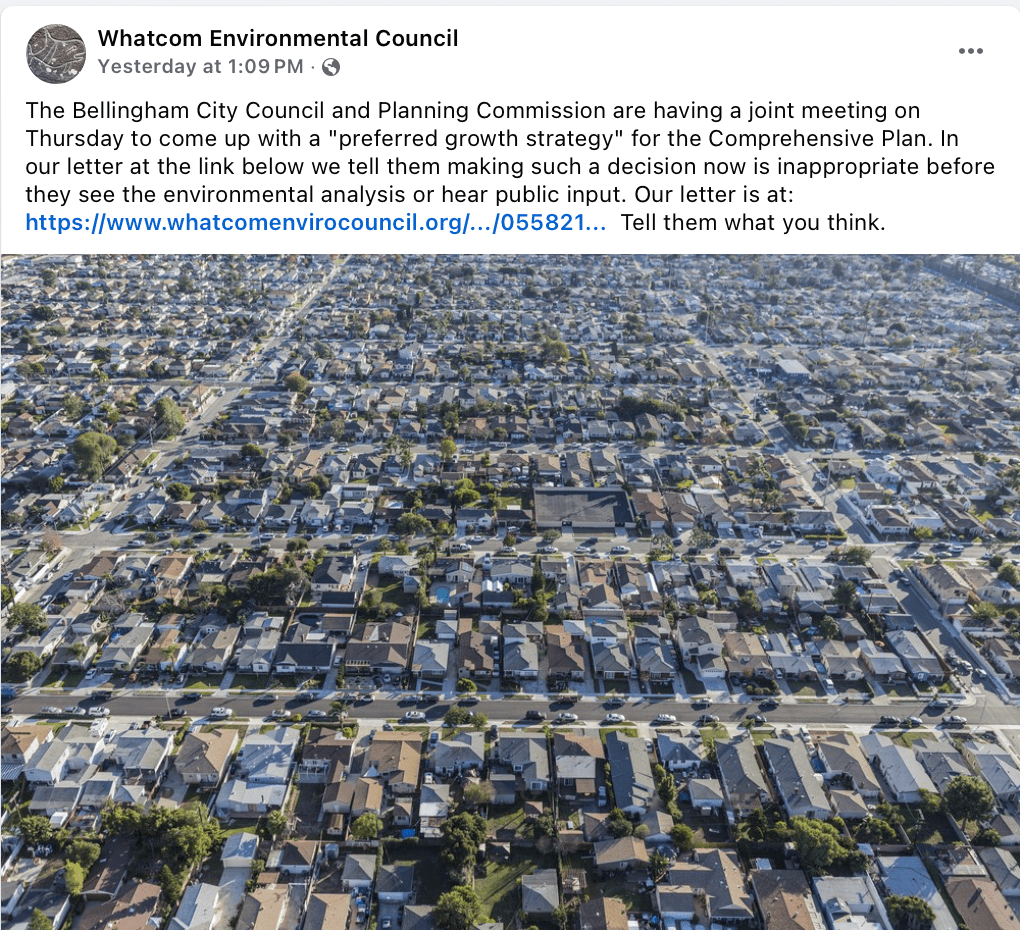
October 22, 2024 Dena Jensen
I sent this email today to support the letter sent by the Whatcom Environmental Council related to their post shown above:
Dear Bellingham City Council and Bellingham Planning Commission:
I am writing in support of the letter sent to you by the Whatcom Environmental Council on October 21, 2024 in opposition to your identifying a preferred growth alternative prior to receiving environmental impact analysis and public input. City leaders and staff need to continue to work earnestly to make significant strides in making opportunities for community input timely and easily/widely accessible when matters critical to the future well-being of community members are being made. Along with this, the input received should be as public-facing as possible, while official decision-making should take the input into account in a meaningful way and should be as transparent as possible.
Sincerely,
Dena Jensen
Birch Bay, WA
[This email was sent to the following addresses: To: ccmail@cob.org <ccmail@cob.org>; Daniel C. Hammill <dchammill@cob.org>; Jace A. Cotton <jacotton@cob.org>; Hannah E. Stone <hestone@cob.org>; Michael W. Lilliquist <mlilliquist@cob.org>; ehwilliams@cob.org <ehwilliams@cob.org>; Hollie Huthman <hahuthman@cob.org>; Lisa A. Anderson <laanderson@cob.org>; planningcommission@cob.org <planningcommission@cob.org>
Cc: planning@cob.org <planning@cob.org>; mayorsoffice@cob.org <mayorsoffice@cob.org>; council@co.whatcom.wa.us <council@co.whatcom.wa.us>; Satpal Sidhu <ssidhu@co.whatcom.wa.us>; PDS_Planning_Commission@co.whatcom.wa.us <pds_planning_commission@co.whatcom.wa.us>; lclemens@co.whatcom.wa.us <lclemens@co.whatcom.wa.us>]
Below is a copy of the content of the 10/21/24 WEC email [link to be able to view the letter online, https://www.whatcomenvirocouncil.org/_files/ugd/055821_e65c90c621654755b90caefb45f37b45.pdf?fbclid=IwY2xjawGFE9NleHRuA2FlbQIxMAABHYrGG3SLe2Qlc5UpJpG0ltD91eC24P4-ocfbz3O9L9d_yJh5Kad3p4YsrA_aem_9m3TE_c4mkKlVwoVSifVAw ]:
October 21, 2024
TO: Bellingham City Council
Bellingham Planning Commission
We believe it is inappropriate for the Bellingham City Council and Planning Commission to identify a preferred growth alternative at your joint meeting this week. We have concerns about transparency regarding the purpose and outcome of this meeting, but also about the specific recommendations that are contained in the staff recommendations found in the packet.
Choosing a preferred growth alternative is not timely. Environmental impact analysis and public input have not been provided to make an informed decision. In fact, the Environmental Impact Statement (EIS) scoping document says “[a]fter receipt and consideration of all comments [Draft EIS], the County will choose a preferred alternative to move forward.”
If you identify a preferred alternative at this stage, the public will believe the City “feels it is best or appears most likely to be approved.” (SEPA Handbook, 3.3.2.2) The SEPA Handbook goes on to say:
“Identifying a preferred alternative may also have disadvantages. The public may feel that the decision has already been made, which can cause frustration with the process.” This is not the time for the City to identify a preferred growth strategy.
There are some recommendations regarding the staff growth strategies we appreciate. First, the removal of areas within Lake Whatcom watershed from the Urban Growth Area is long overdue. Second, we appreciate the recommendation to provide a buffer between Bellingham and Ferndale Urban Growth Areas. Our letter dated August 23, 2024 raised this issue. We would disagree that this area should be placed in a UGA Reserve as that would be inconsistent with the need for a wildlife habitat corridor and connection of critical areas.
Letter to Bellingham City Council and Planning Commission
RE: October 24, 2024 joint work session
pg. 2
Our initial concerns about the suggested growth strategies are what is not included. There is no mention about how growth strategies will consider and integrate actions to address climate resilience or the designation of urban and community forests. These are new GMA requirements, and they must be at the forefront of any growth strategy.
The absence of considering climate resilience and urban forests becomes clear in the suggested growth allocations and maps presented for this meeting.
Staff have suggested that Bellingham increase Bellingham’s historical share of growth from 42.4%1 to 53%, meaning 6,0002 more people to accommodate in your growth planning. If the concept behind this growth strategy is for Bellingham to take significant more population to relieve pressure on rural areas or other cities, you need to look closely at Slide 11. Every urban area except Blaine has requested population allocations that together would result in 125% of the OFM medium growth forecast for Whatcom County.
Shifting growth from rural areas will not take place by oversizing urban areas. Whatcom County tried that approach with the first GMA comprehensive plan adopted in 1997. Yet, growth in rural areas did
not subside. Whatcom County has estimated that the land outside UGAs can accommodate in excess of 14,000 additional housing units (Buildable Lands Report). Rural population allocations must be based on an accurate understanding of designated and vested buildout capacity. If Bellingham were to take additional population to shift growth from rural areas, there must be simultaneous real measures adopted by Whatcom County to limit rural growth.
Slides 21 and 23 in your packet identify potential expansion of the Urban Growth Area in North and South Bellingham UGA Reserves. The slides identify growth potential, as well as necessary public facilities to serve these areas. Consideration of one or both of these expansions is influenced by the growth allocation staff has recommended.
The slides do not identify how expanding urban growth to these areas would address climate resilience, urban and community forests, and open space corridors. We think the following needs to be addressed:
Growing outward has a good chance of increasing vehicle miles traveled, a major contributor to greenhouse gas emissions.
Growing outward can result in significant loss of tree canopy. The Yew Street/Samish Crest
(South Bellingham) area is heavily forested.
Growing outward must be consistent with the designation of open space corridors within and between urban growth areas. Both North and South Bellingham areas are in designated open space corridors.3
Growing outward must consider the protection of critical areas. South Bellingham is designated as a critical wildlife habitat corridor.4
1 Technical Report prepared by Leland Consulting Group
2 See Slide 11 in Agenda Packet; Alt 1 = 24,158 and Alt 2 = 30,310
3 See Parks, Recreation and Open Space Plan
4 See Wildlife Corridor Analysis
Letter to Bellingham City Council and Planning Commission
RE: October 24, 2024 joint work session
pg. 3
In conclusion, we recommend that the City wait until a Draft EIS has been published and public
comments have been received to identify a preferred growth strategy. We think the growth strategies staff have outlined should continue to be explored in the Draft EIS if climate resilience, urban forests, and open space corridors are integrated into that analysis.
We want to remind the city of the importance of transparency as you continue with your planning efforts. The notice of a special meeting received from the City Council office said the meeting was a “work session on the Bellingham Plan, focusing on the city’s future growth policy and land use approach”. The Whatcom Environmental Council received no additional notice of the meeting or agenda, including from the Planning Commission or from the email list we joined for the Bellingham Plan.
The agenda, which presumably has an incorrect location for the meeting as the City Council Chambers, was not made available until late Friday afternoon where we find that the “goal for this joint …. work session is to identify a preferred growth alternative…” Had we not paid attention to the agenda and packet, we would not have found that there were expectations for this work session that we had not anticipated when the special meeting notice went out. We hope that the city becomes more diligent and careful about these issues in the future.
Regards,
David Stalheim, Secretary
Whatcom Environmental Council
C: Kim Lund, Mayor
Whatcom County Council
Whatcom County Executive
**********************************
Carl Weimer, President
Former Whatcom County Council
Stan Snapp, Vice President
Former Bellingham City Council
David Stalheim, Secretary
Retired Planning Director
Rick Dubrow, Treasurer
Retired Owner of A-1 Builders
John Blethen
Retired business owner,
Greenways and Parks Board
Rebecca Craven
Retired Policy Analyst
Rick Eggerth
Retired Litigation Attorney,
Environmental Activist
Oliver Grah
Retired Physical Ecologist and
Water Resource Manager
Jean Melious
Retired WWU Professor
Barry Wenger
Retired Ecology Planner
Email:
whatcomec@gmail.com
Website:
http://www.whatcomenvirocouncil.org
Facebook:
Whatcom Environmental Council
 noisy waters northwest
You must be logged in to post a comment.